Insight|
What is tacit knowledge? The first step in turning experience into systems
What would change if the whole company could use the judgment that lives in your best people's heads?
What is tacit knowledge? The first step in turning experience into systems

Every company has people who are exceptionally good at their work.
Someone who knows what a customer needs after a few words, someone who spots the odd number in a complex document, someone who sets priorities and solves the problem even when the schedule falls apart.
Ask them for their secret, and you often hear something like this:
“You'll know once you try it.” “In cases like this, we usually do it this way.” “You look at the situation and decide.”
It's a real skill, but hard to explain. Knowledge that has become second nature through long experience is called tacit knowledge.
Tacit knowledge: hard to explain, but it keeps work moving
Tacit knowledge is learned through experience and repetition but never fully put into words or documents.
Like the sense of balance on a bicycle, there are moments at work when action comes before explanation.
A customer service rep knows, for the same complaint, which customer needs an apology first and which needs the facts checked. An estimator knows which jobs need a second look even when the base rate is the same.
Explicit knowledge, by contrast, is knowledge expressed so others can use it: manuals, formulas, checklists and procedures.
| Tacit knowledge | Explicit knowledge | |
|---|---|---|
| Form | Experience, intuition, situational judgment | Documents, rules, procedures, examples |
| At work it sounds like | “This one needs a closer look.” | “If the amounts don't match, check the original against the payment record.” |
| How it's passed on | Watching and learning by working together | Reading documented criteria and applying them |
Tacit knowledge is a valuable asset. But if only certain people can use it, their absence becomes a gap in the work.
Why quality wobbles when people change
Even with a manual, new hires often can't produce the same results.
The steps are written down, but what to look at and how to decide at each step is missing.
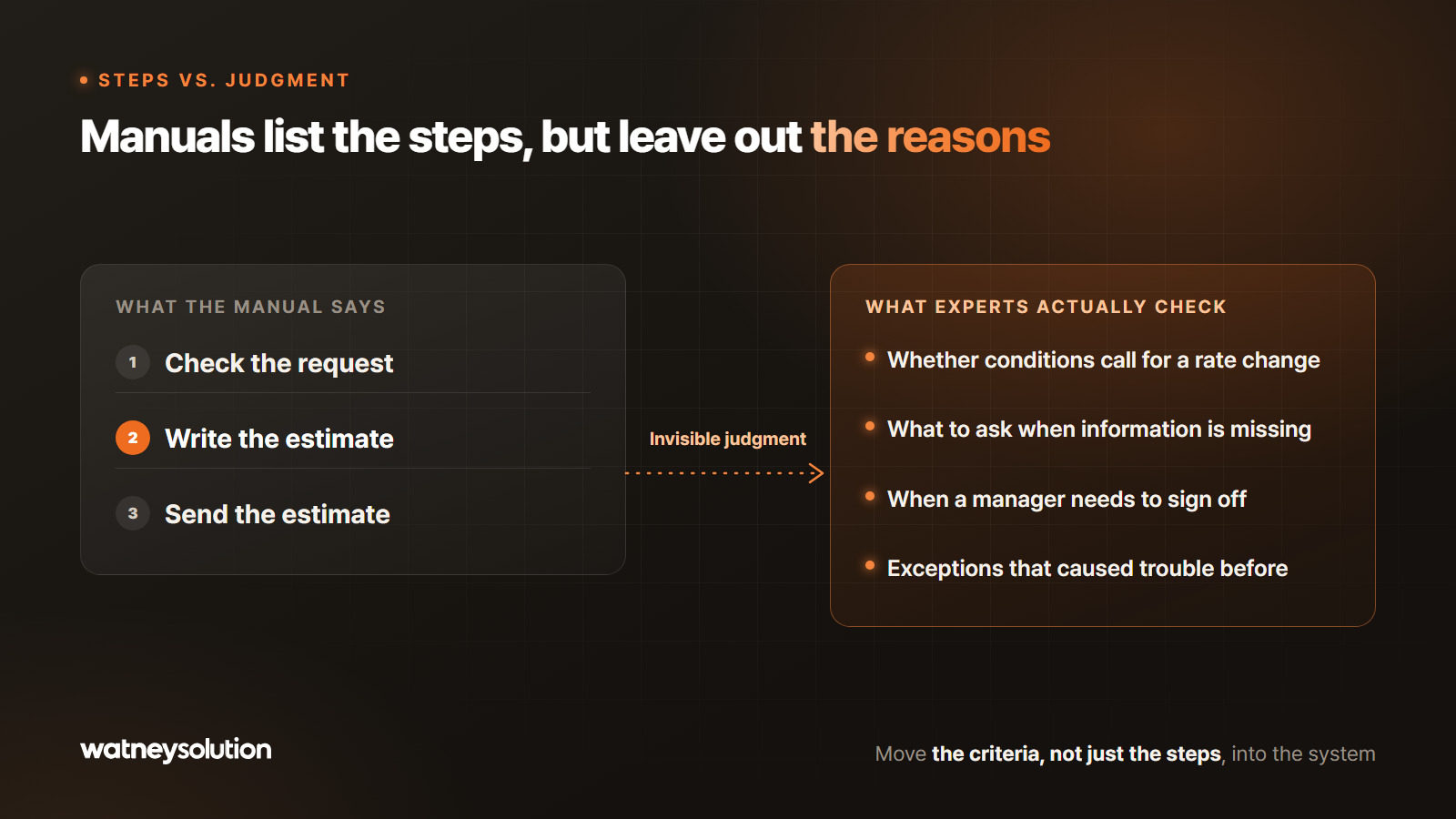
“Write the estimate” isn't enough. You also need to know when to adjust the rate, what to ask when information is missing, and when to get a manager's sign-off.
Experts apply these criteria naturally. Newcomers have to learn them through repeated questions and trial and error.
To move work into a system, you need to capture the reasons behind decisions, not just the order of steps.
Adopting AI doesn't create your company's standards for you
Ask an AI to “reply to the customer tactfully” and you'll get a plausible message. Whether it matches your company's service standards is another matter.
“Tactfully” mixes several meanings.
It might mean acknowledging the customer's frustration first, or not promising anything unconfirmed, or considering a long-term customer's situation while leaving compensation to a manager.
AI answers from the information it's given and the patterns it has learned, but it can't infer internal criteria nobody gave it.
So to use AI at work, you need to spell out:
- What information does the decision need?
- Under what conditions does the handling change?
- What happens when information is missing or an exception occurs?
- What counts as a good result?
- At which step does a person need to check?
Only with these criteria in place can you evaluate and improve what AI produces.
How do you draw out tacit knowledge?
“Please write down all your know-how” is hard even for experts, because it means explaining from scratch what they do without thinking.
Asking about real cases gets much more specific answers.
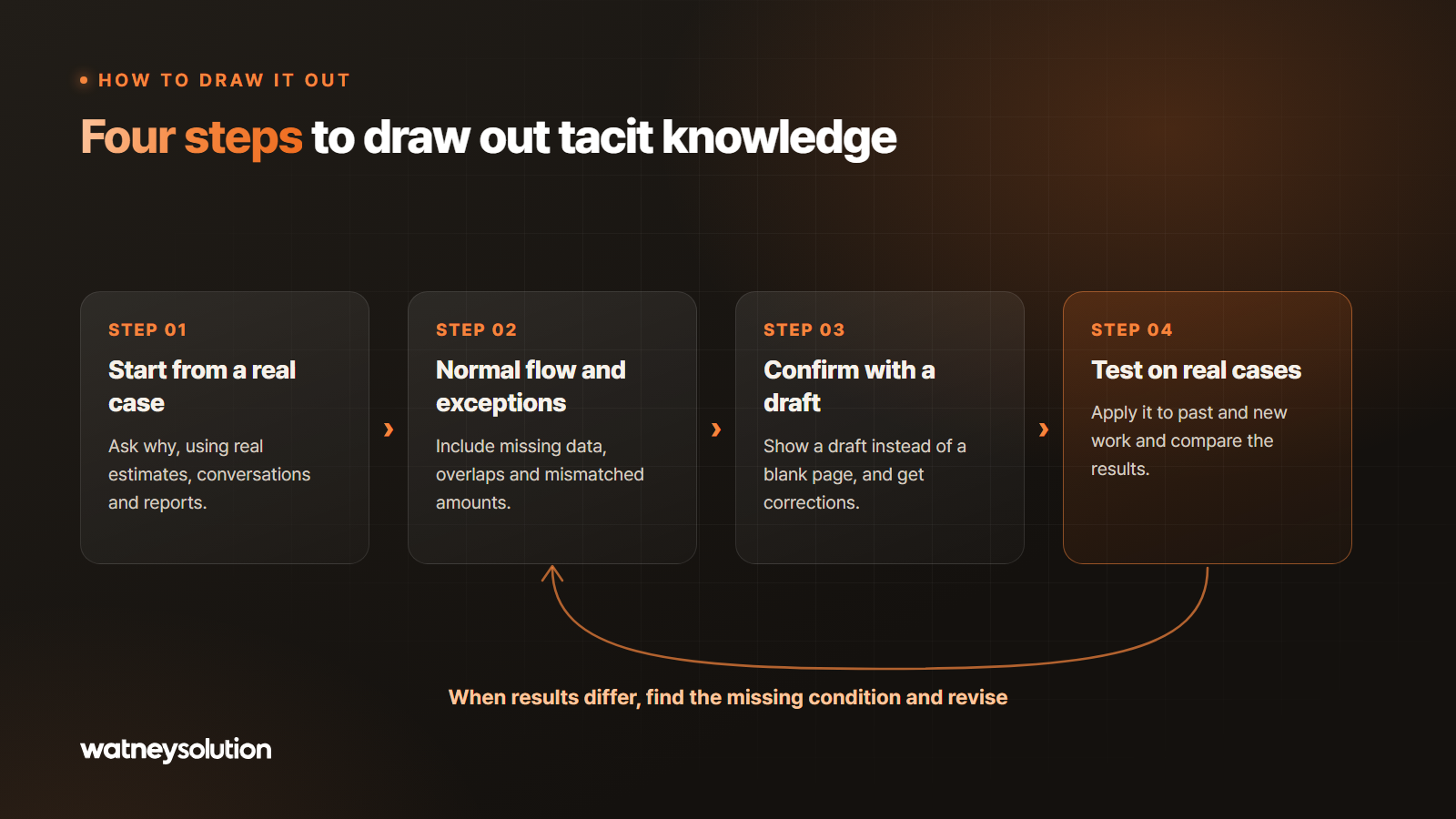
1. Start from a recent case
Look at real material together: a recent estimate, a conversation with a customer, a report before and after revisions.
“Why did you ask a follow-up question here?” “Why did you check this item first?” “What made this one different from other cases?”
Questions like these reveal the judgment hidden behind the result.
2. Look for the exceptions, not just the normal flow
If you only document how things go when everything goes to plan, gaps appear in real operations.
Look at the unusual cases too: missing documents, overlapping schedules, amounts that don't match.
Once you capture how exceptions are noticed and who to check with, the criteria become far more concrete.
3. Show a draft and get corrections
Draft the procedure or criteria from interviews and material, then have the person review it.
“My understanding is that you usually handle it in this order. Are there other cases?”
A draft to compare against real work surfaces missing conditions and exceptions far more easily than a blank document.
4. Test it on real cases
The criteria are still a hypothesis. Apply them to past and new cases and see whether you get the expected results.
If the judgment differs, find the missing information or condition and revise. Only through repetition does it become knowledge the team can use.
Not just a document — connected to the screens people work in
Documented criteria can serve as manuals or checklists. Criteria used again and again can be built into work screens and automation.
Pricing rules can become automatic calculations from inputs; evidence checks can become a review screen showing the source next to extracted values. Situational know-how can become a coaching tool that suggests the next action.
Not every decision needs to be automated.
Work with clear rules, like calculations, can be handled by rules; AI can help with document extraction and drafting replies; and decisions that need interpretation or carry high impact can be designed for a person to confirm.
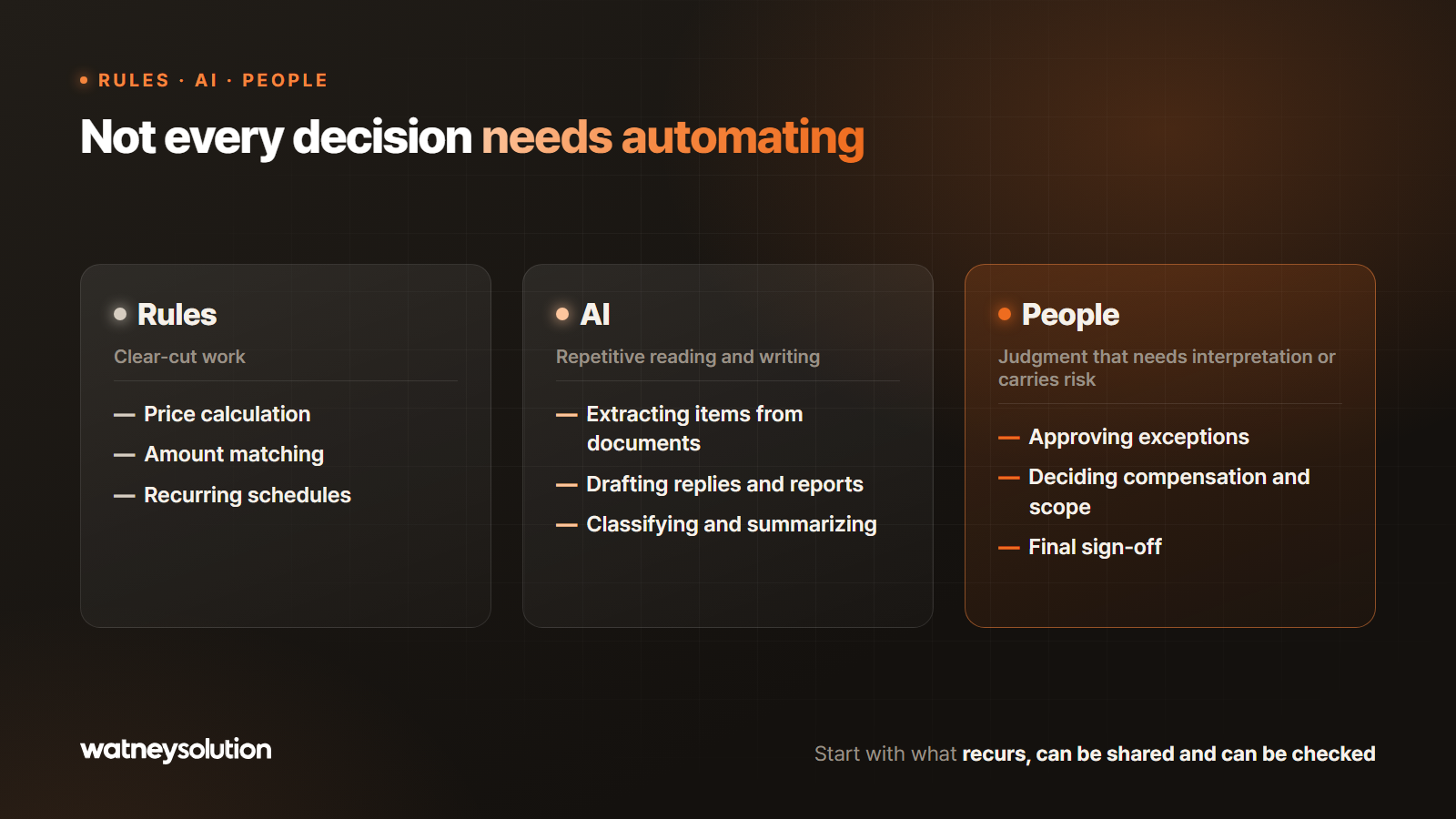
Nor can all tacit knowledge be perfectly documented. The realistic starting point is the parts that recur often, can be passed on and can be verified.
AX starts with understanding the work on the ground
AX — transforming work with AI — starts with understanding real problems and the criteria behind decisions.
Who decides based on what information, where rechecks keep happening, and what result is needed before work can move on.
The goal isn't to clone every expert skill. It's to share the criteria that can be drawn from experience, reduce variation in repetitive work, and let people focus on the decisions that matter more.
Watney Solution works with teams to uncover and organize workflows and judgment criteria, then connects them to the screens, automation and AI features people actually use.
So that people's experience becomes a company asset. Moving tacit knowledge into systems is how that connection gets built.