News|
Watney Solution runs Konkuk University’s 2026 Mobility AI Startup Conference
Twenty students spent one day finding mobility problems, building web MVPs with AI and pitching at Demo Day. Overall satisfaction was 4.81 out of 5.
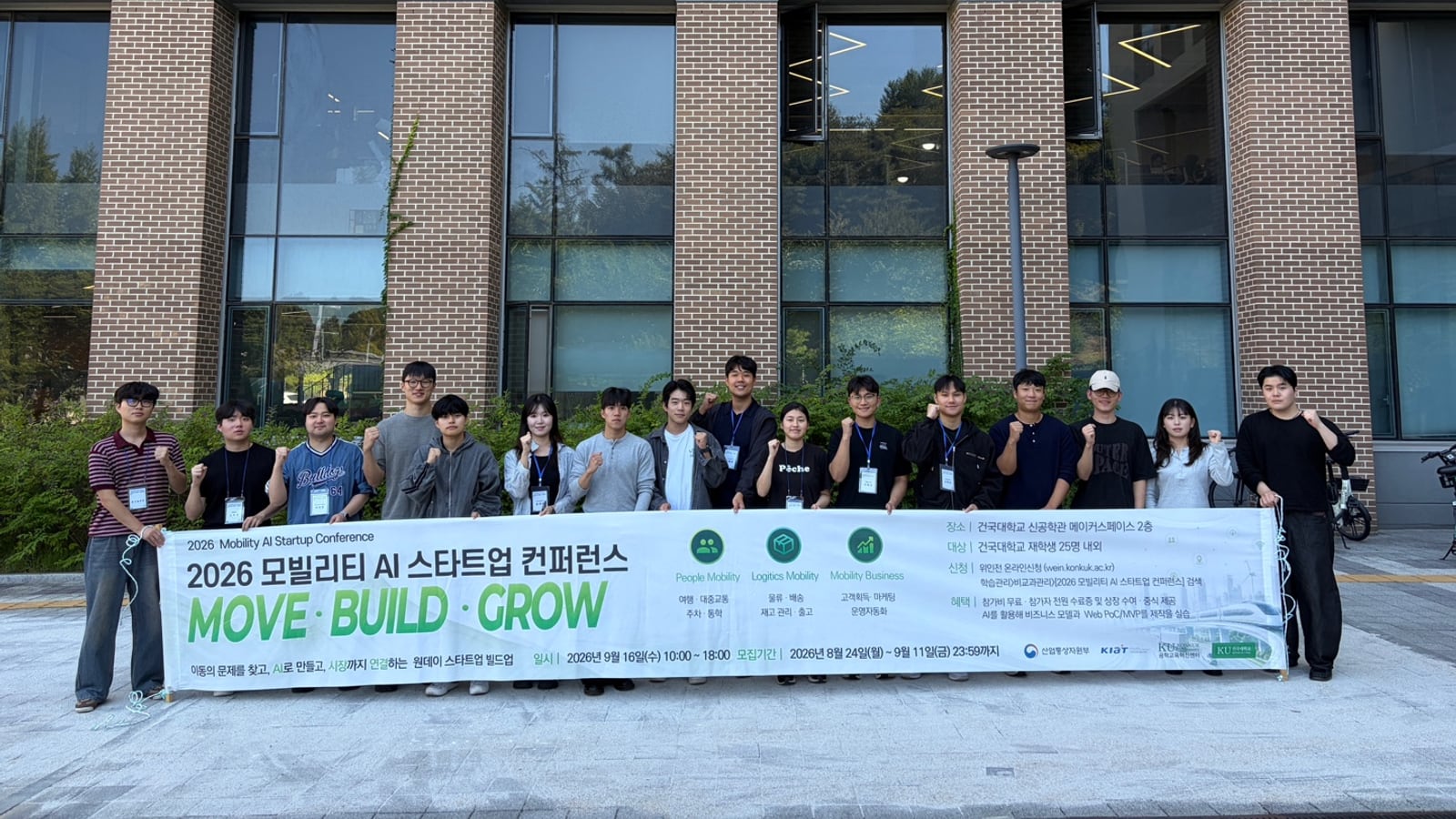
On September 16, Watney Solution ran the program for the 2026 Mobility AI Startup Conference at Konkuk University’s New Engineering Building. Hosted by the Ministry of Trade, Industry and Energy and the Korea Institute for Advancement of Technology (KIAT), and organized by Konkuk University’s Engineering Education Innovation Center, the event ran under the slogan “MOVE · BUILD · GROW” as a one-day startup build-up: find a mobility problem, build a solution with AI, and connect it to a market.
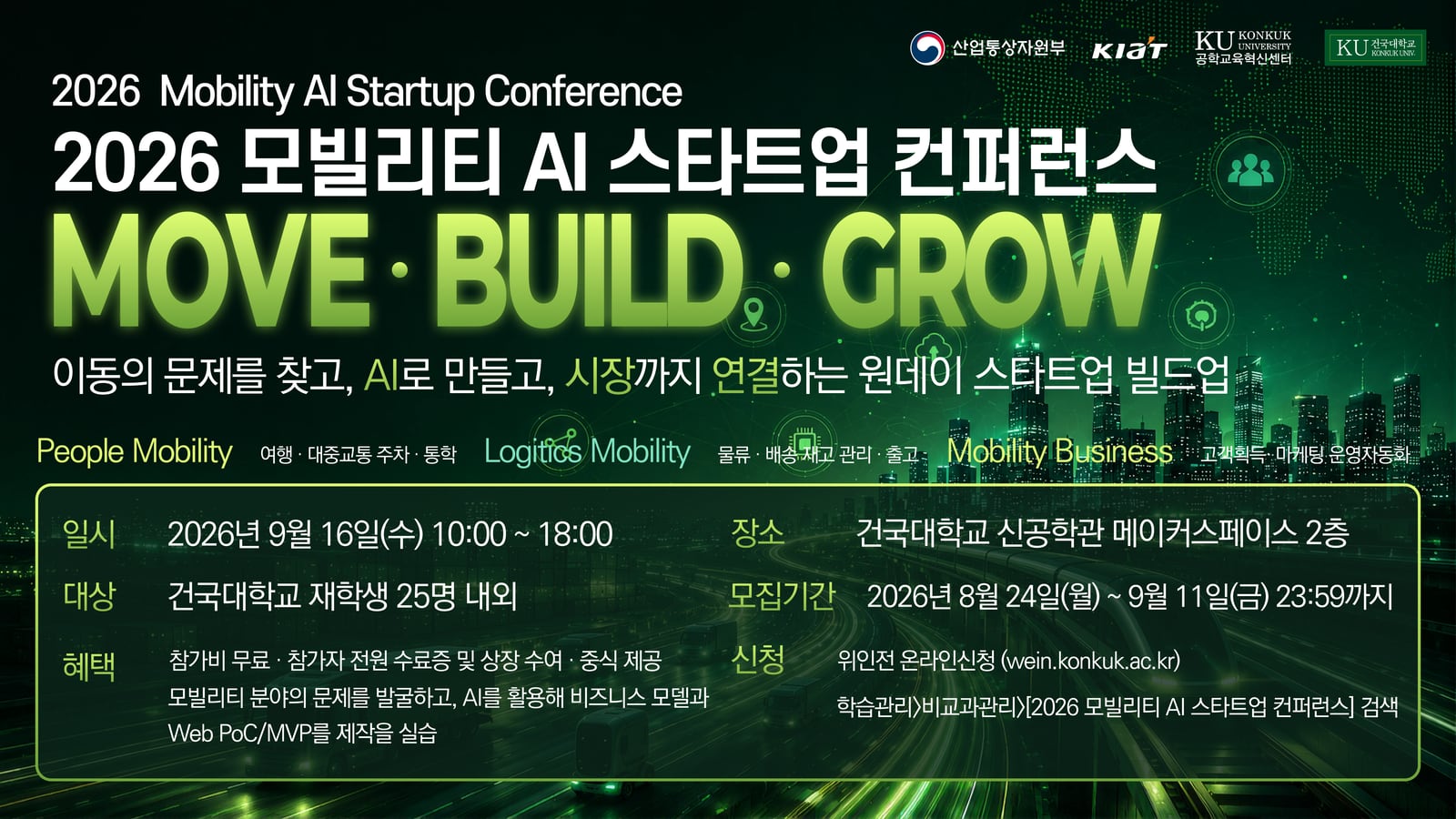
Seeing mobility as “problems in movement”
Rather than limiting smart mobility to cars and technology, the program framed it as the friction and inefficiency that arise whenever people and goods move. Teams chose one of three tracks to define their problem.
- People Mobility — travel, public transport, parking, commuting, tourism
- Logistics Mobility — logistics, delivery, last mile, warehousing and inventory
- Mobility Business — customer acquisition, marketing, data, operations automation
From problem discovery to Demo Day in one day
The program ran from 10 a.m. to 6 p.m. In the morning, teams used generative AI to explore markets, competitors and customer pain points, then chose their problem. In the afternoon, an AX (AI transformation) session on redesigning real work and services with AI led into defining problem, customer, solution and business model.
Most of the day went to the AX Build Sprint, where participants built working web PoCs and MVPs with AI tools. Teams then planned content, social and landing-page strategies to reach their first 100 users, and closed with live demos and five-minute pitches at Demo Day.
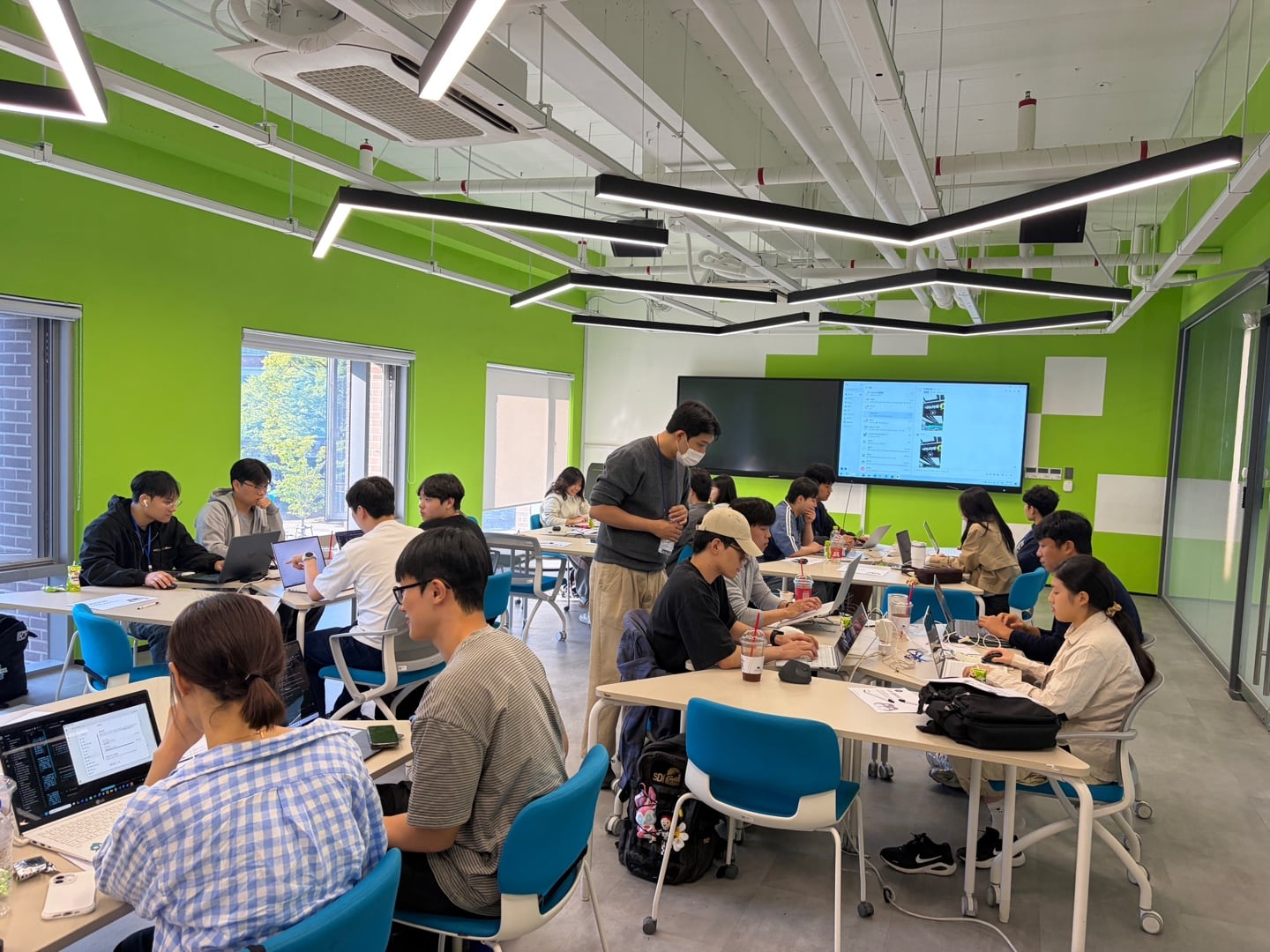
20 students from 11 departments, all five teams presented
Thirty-three students applied, and 20 from 11 departments took part in five teams, including non-engineering majors such as life sciences and liberal studies.
All five teams finished and presented their work within the day. Nine web PoCs and content pieces were submitted, including a tool that turns natural language into task specifications, a whiteboard with AI analysis, and card-news generators for small businesses and local shops. Judging covered problem definition, solution, product quality and use of AI, business model, and early customer acquisition, and all five teams received awards.
4.81 out of 5 — “we could connect AI to real problem-solving and products”
In a survey right after the event (16 responses), overall satisfaction was 4.81 out of 5 and willingness to recommend it was 4.75. Every respondent rated the event satisfactory or better overall.
Instead of using AI indiscriminately, they taught us how to use it by connecting it to how it works. That felt fresh, and it will help me use AI in the long run.
I could think about how to connect AI not as a technology in itself, but to solving real problems and building products.
Some participants said one day wasn’t enough for hands-on work and asked for a multi-day format. Requested follow-up topics included AI agents, AI for autonomous driving, robots and drones, and AI-assisted software and hardware development.
AX that starts from real problems
Watney Solution shared with students the same approach it uses with companies: rather than picking a technology first, start by finding who faces what friction, then turn that problem into something that actually works with AI.
Watney Solution plans to keep sharing this experience of connecting real problems to AI and systems with students, founders and companies.